Arpeggios: The Complete Guide
Arpeggio fingerings you can find fast, play at tempo and use over real changes
$34.99
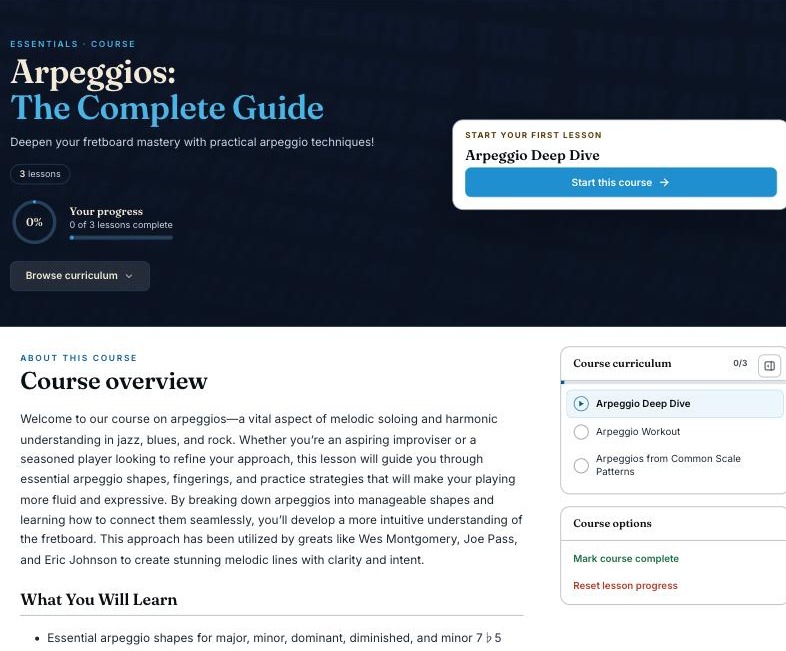
Most arpeggio books, Tim says, teach big sweep-picking shapes that are hard to play and not the most useful in blues or jazz. He works in four-note shapes instead, sorted by which finger plays the root, and joins two when a line needs more range. Then a full workout, and arpeggios drawn from five G major scale patterns.
Every course and lesson on the site, this one included. Free for 7 days, then $24.99 a month.
Start your free trialWhy you'll love it...
Filed by one finger
Every shape is sorted by the finger on the root: little or third finger toward the nut, second finger in the middle, first finger toward the bridge. Three families instead of a hundred grips.
Small shapes, joined when needed
Four-note shapes are how arpeggios get used in blues, jazz and pop. When a line needs more range, Tim joins two small shapes with a slide rather than learning one big one.
Tested at tempo, not just slowly
Tim's warning is that a fingering which works slowly can fail at speed. He has you push each shape faster early, so a faulty fingering shows up before it becomes a habit.
The chromatic bebop move
Up one arpeggio, shift a fret, down the next. It matches the chromatically falling changes that turn up in tunes all the time, and it drills every shape in every quality.
Scales you know, put to work
The third video draws Gmaj7 through F♯m7♭5 out of five G major scale fingerings, using the fingers you already use for the scale, so that practice turns straight into arpeggio vocabulary.
Honest about awkward shapes
Some fingerings are correct on paper and clumsy in the hand, and Tim says so, then shows the alternative he actually plays. You get the system and the judgment to bend it.
What's inside
- 3 videos, 1 hr 42 min in total
- Major 7, dominant 7, major 6 and augmented arpeggio shapes
- Minor-major 7, minor 7 and minor 6 shapes
- Minor 7♭5 and diminished 7 arpeggios, with alternate fingerings
- Fingerings for little, third, second and first finger on the root
- Every shape from A, D, G and C roots across four string sets
- Picking, finger rolls and the chromatic shift drill
- Diatonic seventh arpeggios from five G major scale fingerings
- A PDF each for the Deep Dive and the Workout
- Two PDFs for the scale-pattern lesson
A look inside...
What You'll Learn
1Arpeggio Deep Dive
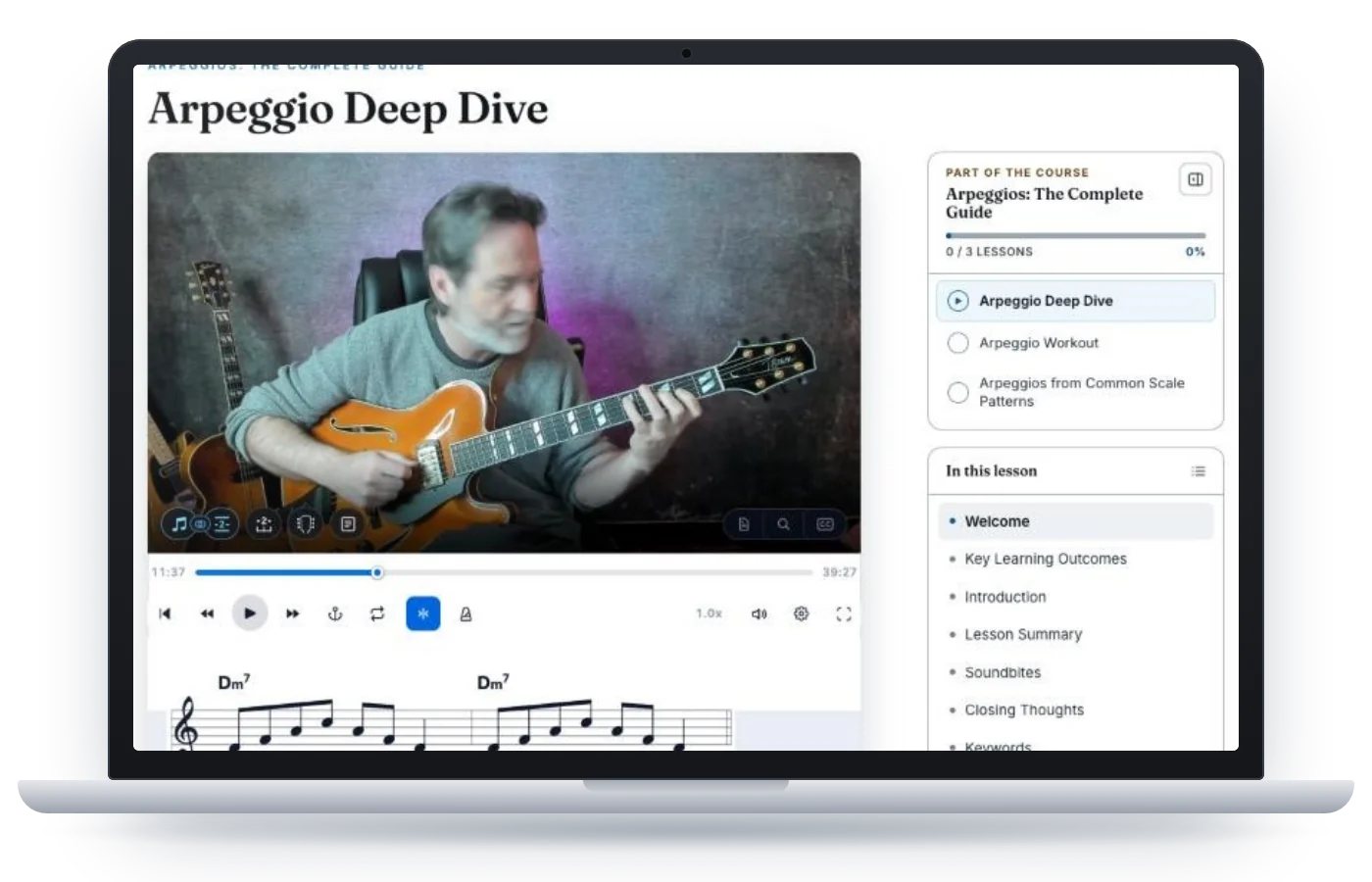
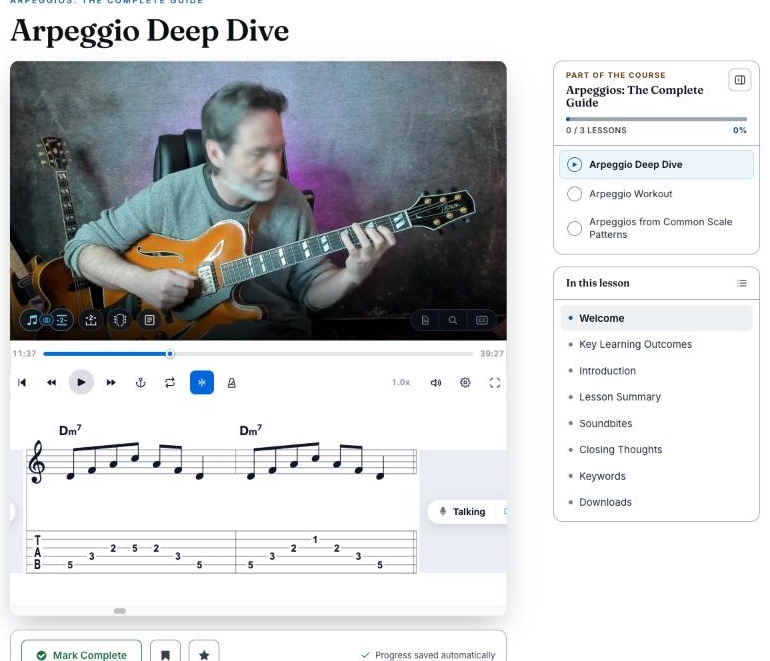
The system itself. Four-note arpeggios grouped by which finger plays the root, across the bottom, lower-middle, upper-middle and top string sets. Major, major 7, dominant 7, major 6 and augmented, then the minor family including minor-major 7 and minor 6, then m7♭5 and diminished. It ends with three ways to practice, the last over a real ii-V-I.
2Arpeggio Workout
Every shape played four times, quality by quality, from A, D, G and C roots, in each of the three finger groups. Tim plays through in real time, points out the alternative fingerings where the B string forces a choice, and reminds you to roll fingers cleanly. It closes with the chromatic drill, up one arpeggio and down the next.
3Arpeggios from Common Scale Patterns
Seventh chord arpeggios from five common G major scale fingerings: second position, three notes per string, a shape starting on B, a tenth-position shape and one starting on E. Each is played slowly, then counted in so you can play along in eighth notes. The minor scale versions are left for you to work out yourself.
Is this for you?
Yes, if…
- You solo from scales and want chord tones under your fingers
- You come from blues or rock and one note per string feels strange
- You know your major scale patterns and want more out of them
- You want a fingering system, not a chart of every possible shape
Maybe not, if…
- You want big sweep-picked arpeggios for rock or metal
- You are new to seventh chords and their names
- You want licks to copy rather than shapes to practice
Why small shapes work better...
Tim calls an arpeggio a fluid chord: every naming rule that applies to a chord applies to its arpeggio as well. What usually goes wrong is the fingering. Arpeggios are often presented in a way he does not find useful, as large patterns that look complete on paper and are hard to play in a solo.
Three families, one logic
This course sorts every four-note shape by the finger that holds the root. With the little or third finger, the shape reaches toward the nut. With the second finger, the notes sit around it. With the first, it reaches toward the bridge. Inside each family a new quality is a small change: lower the top note of a major triad with a doubled root one fret and you have major 7, again for dominant 7, again for major 6.
Practice that tells you the truth
Tim’s recurring point is that slow practice can hide a bad fingering. Anybody can play something slowly. The question is whether the fingering survives at the tempo the music asks for. At the end of the Deep Dive he suggests a workout video would help you actually do the job of learning the shapes, and the second video is that workout. The third ties everything back to scale fingerings you already know.
Even if you have the most advanced formulas in the world, you still have to be creative.
That is how the last video ends. The shapes are information and location. What you play with them is up to you, which is why each video keeps pointing back to using them over real changes.
Questions, answered
How is this different from Triads: The Complete Guide?
Triads stays with three-note chords and the colors you can get from them. This course is about four-note arpeggios played as lines: seventh chord fingerings, how to practice them and how to use them over changes. They pair well, since each arpeggio family here starts from a triad.
Do I need to read music?
No. Every shape is demonstrated on the fretboard and named as Tim plays it. The PDFs give you something to practice from, and the scale-pattern video suggests following the notation, but you can learn all of it by watching.
Can I play these fingerstyle, or do I need a pick?
Either. Tim plays the scale-pattern video fingerstyle and suggests trying both. The Deep Dive talks through alternate and directional picking, because picking is the part of arpeggio playing that most often breaks down at speed.
What level is this for?
Intermediate. You should know your seventh chord names and at least one major scale fingering. Tim moves briskly through the shapes and expects you to go back and learn them a few at a time, even one a day.
How do I get the videos and PDFs?
The three videos play on their lesson pages in Tim's Guitar Workshop once you log in. They stream there rather than download. Each lesson's PDF downloads from its page, and the scale-pattern lesson has two.
Meet your instructor...

Tim Lerch
Tim has played jazz and blues guitar for more than 50 years. He is a member of the Northwest gypsy jazz group Pearl Django, leads the Tim Lerch Trio, plays in a duo with Jamie Findlay, and is an Emmy award-winning composer.
His teaching comes from the players who taught him. Joe Diorio was one of his mentors at GIT, and he learned his approach to chord voicings directly from Ted Greene. Those ideas run through every lesson in the Workshop.
His books include Melodic Jazz Guitar Chord Dictionary, Melodic Jazz Guitar Chord Phrases and Melodic Blues Guitar Soloing. He has recorded ten master class courses for TrueFire and taught at jazz guitar camps in the US and UK.
- Emmy-winning composer
- Member of Pearl Django
- 50 years performing
Buy it on its own, or get everything
- Yours to keep, on your My Courses page
- Video lessons with the notation, on any device
- No subscription
- This and every other course and lesson
- Livestreams and the member community
- New releases every week