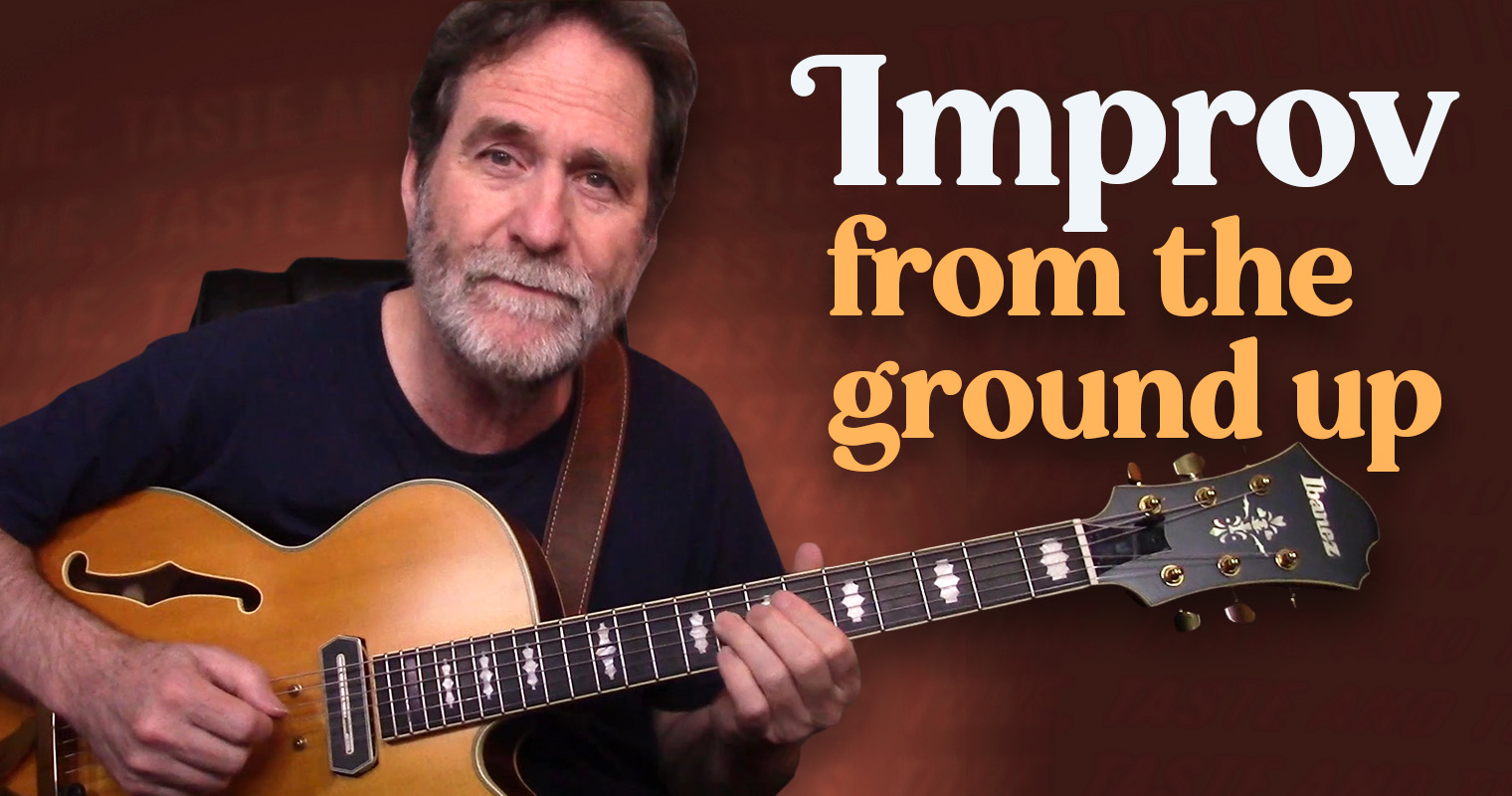
Improv from the Ground Up
Learn what to play over the changes, and when to play nothing at all.
$24.99
Most improvisation teaching is about which scale goes over which chord. Tim covers that, then spends just as long on the subtler question: what not to play, when not to play it, and how a phrase actually gets shaped. Built on Autumn Leaves and Body and Soul rather than exercises.
Why you'll love it...
Silence is treated as a choice
Tim gives as much attention to when not to play as to what to play. Almost nothing else teaches phrasing that way, and it is the fastest route to sounding less mechanical.
Thirds before everything else
Targeting chord tones, and the third in particular, is the spine of both lessons. Get that landing right and a simple line sounds intentional rather than approximate.
Real tunes, not drills
Autumn Leaves carries the first lesson and Body and Soul the second, so every idea arrives inside music you can go and play afterwards.
From exercise to expression
The second lesson is explicitly about crossing over: taking structured practice material and letting it turn into free, expressive playing rather than recited patterns.
Tools for the awkward bars
Chromatic enclosures, arpeggio decoration and rhythmic motifs, plus a clear approach to the non-diatonic chords that usually derail a solo.
A method, not just content
Sequences, ear training and looper work are built into the lessons, so you finish with something to do rather than only something to know.
What's inside
- 2 videos, 53 min in total
- Major and minor ii-V-I progressions, and how to move through them
- The G major scale applied directly to Autumn Leaves
- Melodic variation built from the song's own structure
- Sequences and patterns that connect scales to changes
- Chromatic movement, and resolving it onto chord tones
- Targeting chord tones, with the third as the priority
- Chromatic enclosures and arpeggio decoration
- Rhythmic motifs for phrasing that breathes
- Ear training and looper-based practice suggestions
What You'll Learn
1Improv From The Ground Up: Autumn Leaves
Major and minor ii-V-I progressions, and improvising through them. The G major scale applied straight to Autumn Leaves, then simple melodic variations drawn from the song's own structure. Sequences and patterns to connect the scale to the changes, chromatic movement, and resolving cleanly onto chord tones. Ends with ear training and looper practice.
2Improv From The Ground Up: Body and Soul
The first eight bars of Body and Soul, in D flat. Targeting chord tones with the third as the priority, and what to do when a chord sits outside the key. Chromatic enclosures, arpeggio decoration and rhythmic motifs, then the harder question of moving from structured practice into free playing.
Is this for you?
Yes, if…
- You can play through a standard but your solos wander
- You know some scales and cannot make them sound like music
- You want phrasing addressed, not just note choice
- You are willing to work on two tunes properly
Maybe not, if…
- You have never improvised and want a first introduction
- You want licks to drop in without changing how you think
- You are looking for fast, dense, technical playing
The part most courses skip...
There is a version of improvisation teaching that never quite works. It tells you which scale fits which chord, you learn the scale, and your solos still sound like scales.
Tim names that problem in the opening minute of the second lesson. The emphasis, he says, usually falls on what to play. The more subtle subject is what not to play, when not to play it, and how you build a phrase in the first place.
Two tunes, worked properly
The first lesson takes Autumn Leaves and the major and minor ii-V-I progressions inside it. Rather than running the G major scale as an exercise, you take the song’s own shape and make variations from it, then start connecting scales to changes with sequences and a little chromatic movement.
The second lesson moves to the first eight bars of Body and Soul and gets more specific. Targeting chord tones, particularly thirds. What to do when a chord sits outside the key. Chromatic enclosures and arpeggio decoration. Rhythmic motifs, so a line has shape rather than just correctness.
Practice that goes somewhere
Both lessons end pointing at the same place: the crossing from structured practice into playing freely. Tim suggests looper work and ear training as the bridge, because the material only becomes yours once you are using it without thinking about it.
Two tunes, two lessons, and a way of listening to your own lines that outlasts both.
Questions, answered
Do I need to read music?
No. Everything is played and explained on the guitar. Being able to follow a chord chart helps, since both lessons work through the changes of a standard, but standard notation is never required to keep up.
Do I need to know these two tunes already?
It helps but is not required. Tim works through the harmony of both as he goes. If you want to prepare, spend some time with Autumn Leaves first, since it carries the whole of the first lesson.
Is this about jazz specifically?
The tunes are jazz standards, but the thinking transfers. Targeting chord tones, phrasing and knowing when to leave space apply to blues and to any style where you improvise over a set of changes.
Will this suit a complete beginner at soloing?
Not quite. You should be able to play through a standard and have some scale knowledge already. This is aimed at the player whose solos are technically fine but do not yet sound like music.
Is this included in the membership?
Yes. It runs as a course inside the Workshop, so members already have it along with everything else. Buying it here is for players who want this one course outright rather than taking on a membership.
Members get every course, lesson and livestream — included.
One membership. The whole Workshop, plus the community and new releases every week.