

Soloing Strategies
Turn scales, arpeggios and color tones into solos that tell one story.
$24.99
Knowing which scale fits is the easy part. Tim takes two standards and shows what comes next: the first eight bars of Autumn Leaves worked one tool at a time, from scales and pentatonics to enclosures, then four choruses of All The Things You Are, each with its own focus, building a solo with an arc.
Every course and lesson on the site, this one included. Free for 7 days, then $24.99 a month.
Start your free trialWhy you'll love it...
One tool at a time, then mixed
Scales, pentatonics, arpeggios, enclosures and rhythm are each practiced cleanly on their own first. Then they are blended, which is how isolated exercises turn into a vocabulary you can improvise with.
The changes standards share
The opening of Autumn Leaves holds a major ii-V-I, a I-IV and a minor ii-V-i. Get comfortable soloing through those eight bars and you have covered ground that turns up in tune after tune.
Color where it counts
A D♯ over B7, a 9 and a 6 added to pentatonic shapes, 7♭9 and diminished arpeggios over the dominants. Small choices that give a line the right harmonic pull instead of a generic scale sound.
A solo with an arc
All The Things You Are is built over four choruses, each with its own focus. You hear how a solo can develop from the first chorus to the last rather than staying in one gear throughout.
Ideas that stay connected
Motif development is the heart of the second lesson: one phrase asks, the next answers, and an idea is stayed with until it runs out of steam rather than swapped for something unrelated.
Blues inside a rich standard
Quartal melodies, stacked fourths over minor chords and a bluesy touch on a tune known for its key changes, balanced against longer linear lines so neither takes over.
What's inside
- Soloing Strategies: Autumn Leaves, a video lesson of about 24 minutes
- Soloing Strategies: All The Things You Are, in a notation player
- A PDF for each lesson
- The first eight bars of Autumn Leaves, from Am7 to the minor ii-V-i
- Pentatonics with added 9 and 6, plus 7♭9 and dim7 arpeggios
- Enclosures, chromatic approaches and arpeggio up, scale down
- Four improvised choruses of All The Things You Are at 80 bpm
- Motifs, sequences, triads, bebop ornaments and quartal lines
A look inside...
What you'll learn...
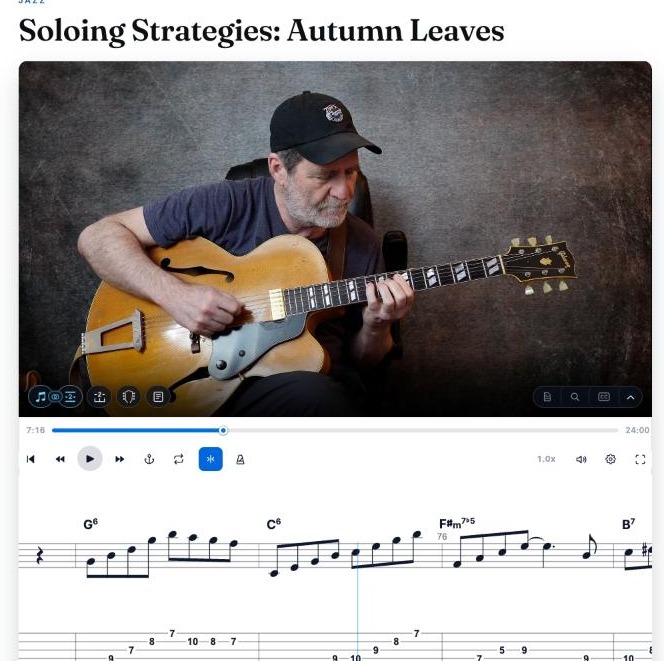
1Soloing Strategies: Autumn Leaves
The first eight bars (Am7, D7, Gmaj7, Cmaj7, F♯m7♭5, B7, Em7, E7) as a practice ground: a ii-V-I in G, a I-IV, and a minor ii-V-i into E minor. The G major scale with D♯ over B7, minor pentatonics with the 9 and 6, arpeggios, 7♭9 and diminished sounds over the dominants, enclosures, rhythmic themes, then a mixed vocabulary. About 24 minutes.
2Soloing Strategies: All The Things You Are
Four improvised choruses at a relaxed 80 bpm over quarter-note rhythm guitar. Chorus one develops a single motif, chorus two builds longer lines from scale and arpeggio sequences, chorus three brings in triads, bebop ornaments and quartal sounds over minor chords, and chorus four adds a bluesy touch. Double time and triplets keep the slow tempo moving.
Is this for you?
Yes, if…
- You know which scale fits the changes but your solos sound like scales
- You can play seventh chord arpeggios and want them to sound like lines
- You want to shape a solo across choruses, not phrase by phrase
- You would rather work on real tunes than on exercises
Maybe not, if…
- You are new to improvising and still learning your first scale shapes
- You want a transcribed solo to learn note for note
- You are after fast bebop vocabulary at tempo
From exercises to music...
Most players who start improvising on jazz standards hit the same wall. They learn the right scale, play it over the changes, and within a few bars it is clear that a scale run up and down is not yet a solo.
These two lessons take two different routes past that wall.
Autumn Leaves: one tool at a time
The first eight bars of Autumn Leaves hold a great deal of what turns up again and again in standards: a major ii-V-I, a I-IV, and a ii-V-i in the relative minor. That makes them a compact place to practice. Tim starts with the G major scale as a map, with a D♯ over B7, then works through pentatonics, arpeggios, enclosures and rhythmic themes, each practiced cleanly before they are blended.
Before you can decorate the house, it helps to know where the rooms are.
All The Things You Are: a solo with an arc
The second lesson slows Jerome Kern’s tune to 80 beats per minute and builds four choruses, each with a different focus. The first is almost entirely one motif, developed rather than dropped, with one phrase asking and the next answering. Sequences, triads, bebop ornaments, stacked fourths and a touch of the blues follow, so the solo grows rather than lurching from idea to idea.
Taken together, the two lessons cover both halves of the problem: what to play over a set of changes, and how to keep a solo telling one story from the first chorus to the last.
Questions, answered
How is this different from Improv from the Ground Up?
Both start from Autumn Leaves, so there is common ground. Improv from the Ground Up pairs it with Body and Soul and spends its time on phrasing and what not to play. Soloing Strategies is a toolbox: pentatonics with color tones, 7♭9 and diminished arpeggios, enclosures, then a four-chorus solo arc on All The Things You Are.
Why only the first eight bars of Autumn Leaves?
Because they hold most of the tune's harmony. The second half repeats much of the same information in a different order, so the opening eight bars give you a major ii-V-I, a I-IV and a minor ii-V-i in one compact place to practice.
Do I need to read music?
It helps. Each lesson comes with a PDF, and the All The Things You Are lesson plays in a notation player, so the ideas are on the page as well as on the video. The relaxed 80 bpm tempo of that lesson gives you time to follow along.
What should I know before I start?
You should be comfortable with the major scale and with seventh chord arpeggios, and have had a go at improvising over a standard. The lessons are about turning those tools into music, so they assume you already have a few of them in hand.
How do I get the lessons?
Both lessons play on their lesson pages in Tim's Guitar Workshop once you log in. The videos are not a download. Each lesson's PDF downloads from its own page. The Autumn Leaves lesson runs about 24 minutes.
Meet your instructor...

Tim Lerch
Tim has played jazz and blues guitar for more than 50 years. He is a member of the Northwest gypsy jazz group Pearl Django, leads the Tim Lerch Trio, plays in a duo with Jamie Findlay, and is an Emmy award-winning composer.
His teaching comes from the players who taught him. Joe Diorio was one of his mentors at GIT, and he learned his approach to chord voicings directly from Ted Greene. Those ideas run through every lesson in the Workshop.
His books include Melodic Jazz Guitar Chord Dictionary, Melodic Jazz Guitar Chord Phrases and Melodic Blues Guitar Soloing. He has recorded ten master class courses for TrueFire and taught at jazz guitar camps in the US and UK.
- Emmy-winning composer
- Member of Pearl Django
- 50 years performing
Buy it on its own, or get everything
- Yours to keep, on your My Courses page
- Video lessons with the notation, on any device
- No subscription
- This and every other course and lesson
- Livestreams and the member community
- New releases every week