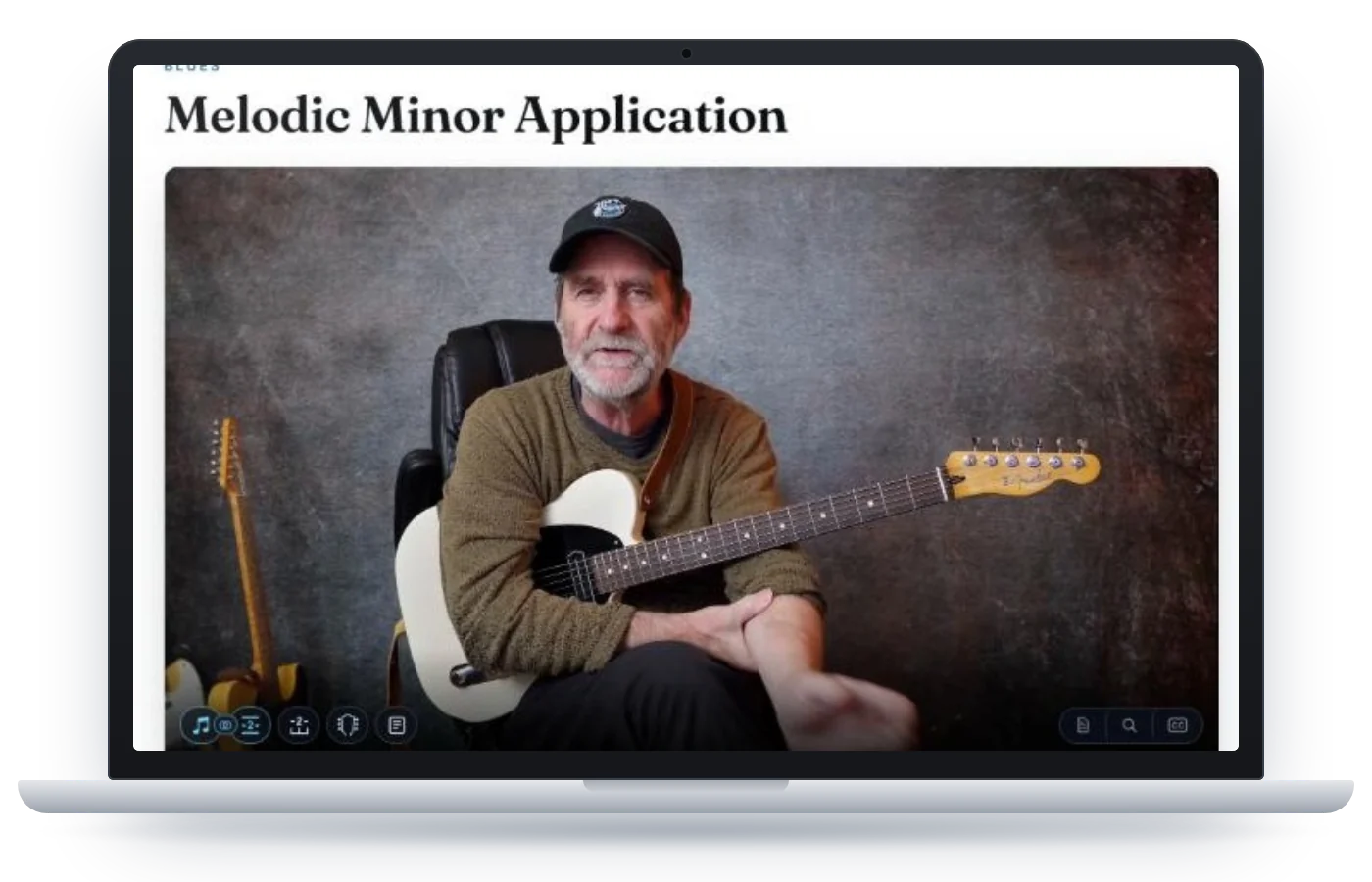
Melodic Minor Application
Altered, Lydian dominant and tonic minor sounds from one scale, played as melody
$24.99
Melodic minor is usually taught as a rule: up a half step over an altered dominant. Tim starts there, then covers the four chords it suits best. The second half slows right down, taking each note of the scale over E7 altered and resolving it into A minor, then A major.
Every course and lesson on the site, this one included. Free for 7 days, then $24.99 a month.
Start your free trialWhy you'll love it...
Tension you learn to trust
Guitarists tend to back off a strange note as if it were a mistake. Resolving each altered tone by half or whole step teaches you to hear it as tension heading somewhere.
One fingering, four chords
Learned from its own root, F melodic minor covers E7 altered, B♭7♯11, Fm6 and Dm7♭5. One shape learned properly, four harmonic situations covered.
Lines, not runs
Arpeggios of the scale's own seventh chords give you shapes to phrase with, each one landing on the next chord rather than running up and down and hoping.
What's inside
- One video, 37 minutes
- Building melodic minor and hearing it as its own scale
- The seven seventh chords of F melodic minor, FmMaj7 to Em7♭5
- Altered dominant: melodic minor a half step above the root
- Lydian dominant over sevenths that do not resolve, such as IV7
- Tonic minor over a minor 6 chord
- Minor 7♭5: the melodic minor a minor third above the root
- Note-by-note resolutions from E7 altered into A minor and A6
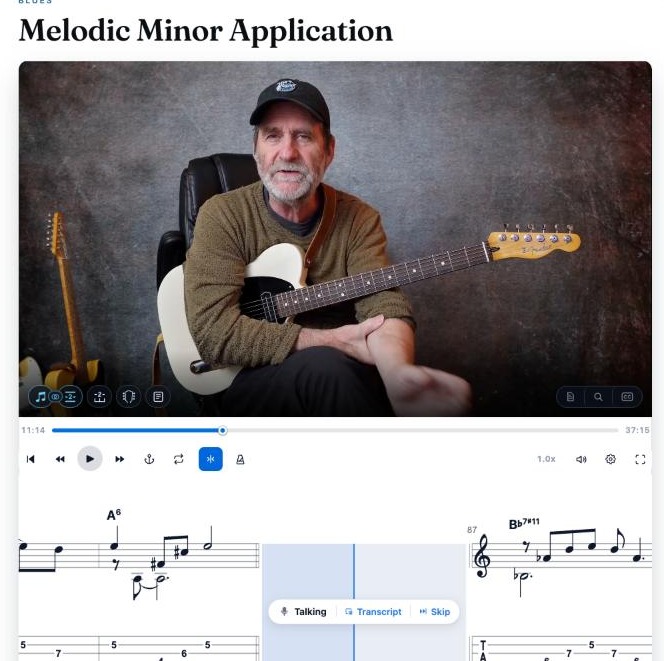
- Arpeggio lines drawn from the scale's seventh chords
- The lesson PDF
A look inside...
Is this for you?
Yes, if…
- You know the altered scale rule but it still sounds like wrong notes
- You play major or Dorian scale fingerings and want the next scale
- You play jazz or modern blues over dominant seventh chords
- You are willing to work slowly, one note at a time
Maybe not, if…
- You want several fingerings of the scale across the neck
- You are new to seventh chords and chord symbols
- You want licks to copy rather than a sound to learn
One scale, four jobs...
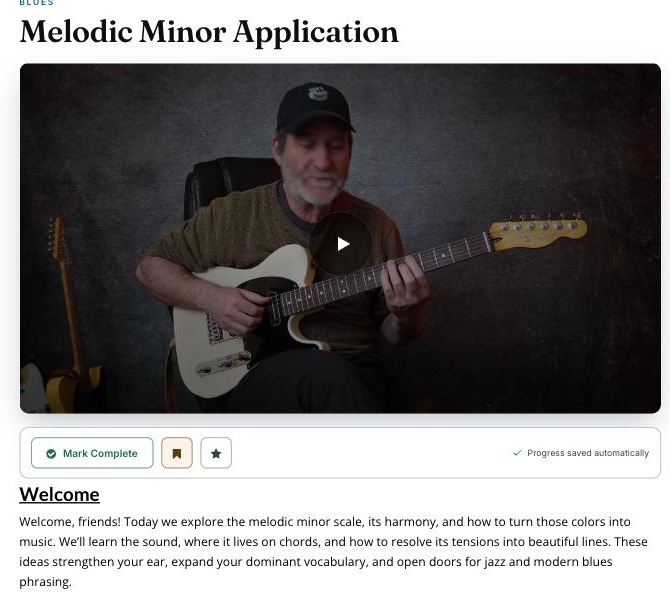
Tim opens by saying that construction, harmony and application go together and cannot really be learned separately. That is how this lesson runs, and why it is a little theory heavy. He asks you to hang in there, because the sounds at the end are some of the most satisfying in jazz and modern blues improvisation.
Where it fits
Everything is shown from F melodic minor. Over E7 altered it is the altered scale, a half step above the root. Over a B♭7 that does not resolve, like the IV7 in a blues or the II7 in Girl from Ipanema and Take the A Train, it gives the Lydian dominant sound. Over Fm6 it is a more refined tonic minor than Dorian, and over Dm7♭5 it brings in a natural ninth.
Then the slow part
With a loop of E7♯5♭9 resolving to A minor, Tim takes every note of the scale in turn and moves it to the nearest note of the arrival chord. Then he repeats the exercise into A6, and explains why he chose A6 over Amaj7: Amaj7 shares a note with the scale and so gives up one of the resolutions. Only after that does he turn the scale’s seventh chords into arpeggio lines.
Probably the worst thing you can do is play it from low to high.
That line sums up the lesson. The fingering is only the starting point. The aim is a sound you can hear coming, and a line that knows where it is going to land.
Questions, answered
How much theory do I need?
Comfort with seventh chords and chord symbols, and one major or Dorian scale fingering to start from. Tim says up front the lesson is a little theory heavy. He builds the scale and its harmony from scratch, so no previous melodic minor study is needed.
Does it cover fingerings across the whole neck?
No. Tim uses one F melodic minor fingering throughout and says so at the start. His advice is to learn that one shape as its own scale, from its own root, before adding more, so the applications do not turn into arithmetic on the fly.
I have the Diminished Harmony Deep Dive. Is this the same?
No. Both give you options over dominant seventh chords, but they come from different scales. The Diminished Harmony Deep Dive is built on a symmetrical scale. This lesson stays with melodic minor, its seven chords and its four common uses.
Do I need a looper?
No, but it helps. Tim uses a freeze pedal and a looper on the video, and suggests recording a bar of E7 altered resolving to A minor, then to A major, to practice over. Any looper or recording you can play along with will do.
How do I get the video and PDF?
The video plays on its lesson page in Tim's Guitar Workshop once you log in. It streams there rather than downloads. The PDF downloads from the same page, so you can keep it beside you while you practice.
Meet your instructor...

Tim Lerch
Tim has played jazz and blues guitar for more than 50 years. He is a member of the Northwest gypsy jazz group Pearl Django, leads the Tim Lerch Trio, plays in a duo with Jamie Findlay, and is an Emmy award-winning composer.
His teaching comes from the players who taught him. Joe Diorio was one of his mentors at GIT, and he learned his approach to chord voicings directly from Ted Greene. Those ideas run through every lesson in the Workshop.
His books include Melodic Jazz Guitar Chord Dictionary, Melodic Jazz Guitar Chord Phrases and Melodic Blues Guitar Soloing. He has recorded ten master class courses for TrueFire and taught at jazz guitar camps in the US and UK.
- Emmy-winning composer
- Member of Pearl Django
- 50 years performing
Buy it on its own, or get everything
- Yours to keep, on your My Courses page
- Video lessons with the notation, on any device
- No subscription
- This and every other course and lesson
- Livestreams and the member community
- New releases every week