
Tim Comps For You – Playalong with Tim vol.2
Play the melody and take your solo over twenty standards, with Tim comping.
$29.99
A backing track never listens. These twenty play-alongs from Tim’s Tune of the Month series are Tim on guitar, comping the changes himself: ballads, bossa novas, walking bass lines and a relaxed two-feel, with a PDF chart for each tune so you can learn the melody, then solo over the same form.
Every course and lesson on the site, this one included. Free for 7 days, then $24.99 a month.
Start your free trialWhy you'll love it...
Comping that breathes
Real voicings, inner voices that move, passing chords and a walking bass when the tune wants one. Playing over Tim feels much closer to playing with a guitarist than with a loop.
Keys and tempos to choose from
Skylark comes in three keys, Easy To Love in two, and Anthropology at two tempos. Start where it feels natural, then move the same tune somewhere less comfortable.
Every feel a standard asks for
Bossa nova, a relaxed Latin feel, a two-feel, walking bass and the light four-to-the-bar shooping rhythm on Bye Bye Blues. Your time feel gets tested in more than one setting.
Melody first, then your solo
Each track works twice over: once for learning the melody against the harmony, then again as the backdrop for improvising, or for chord melody ideas of your own.
Tim's changes, not just a chart
Nature Boy is Tim's own reharmonized arrangement, and Tenderly and Nature Boy both come with a sheet of Tim's changes. You hear and see how he hears the tune.
Slow enough to think
Many of the tunes are ballads, from Ruby, My Dear to God Bless the Child. The slower tempos leave room to place each phrase rather than chase the changes.
What's inside
- 25 play-along videos of Tim comping, covering 20 tunes
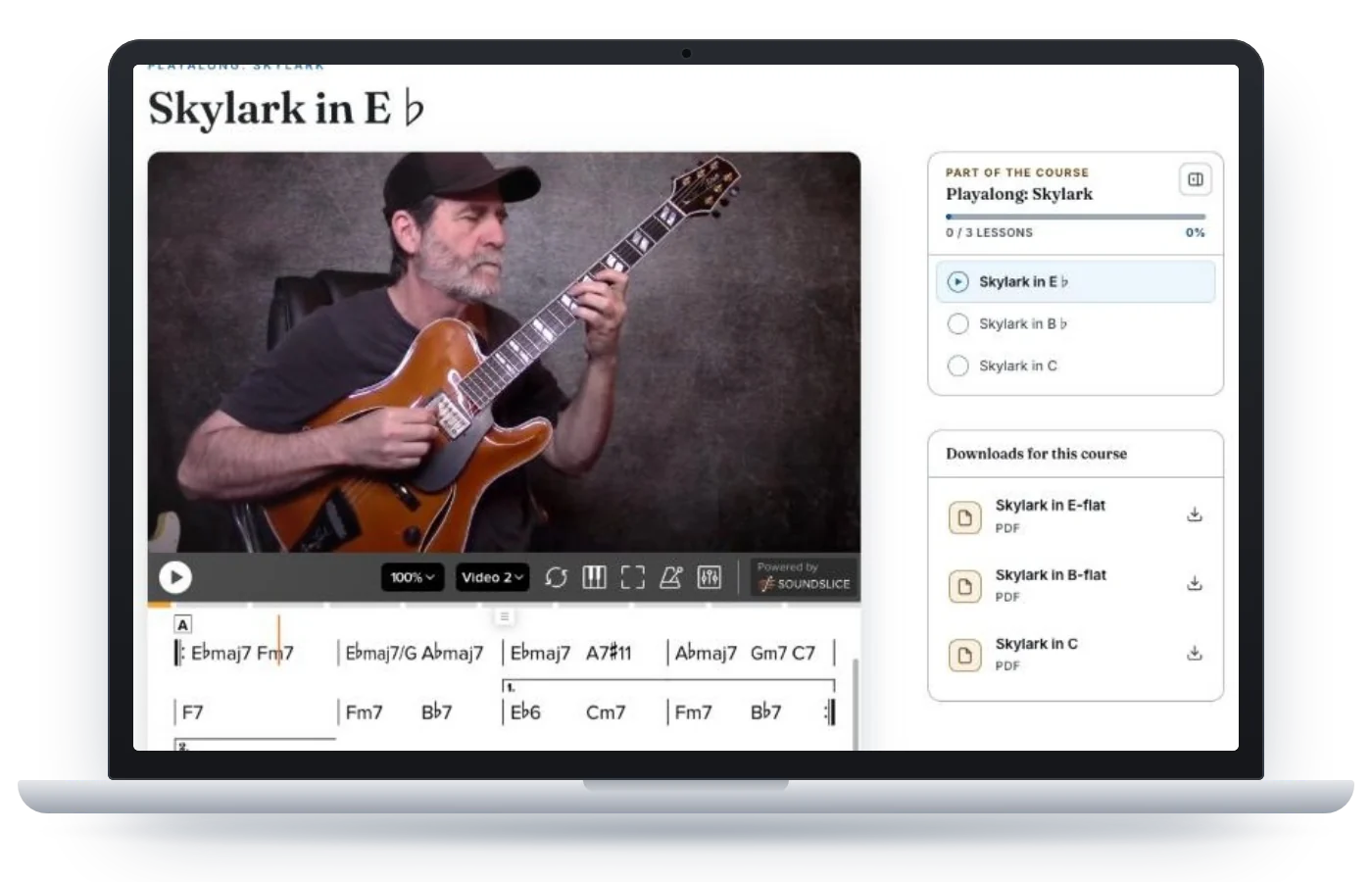
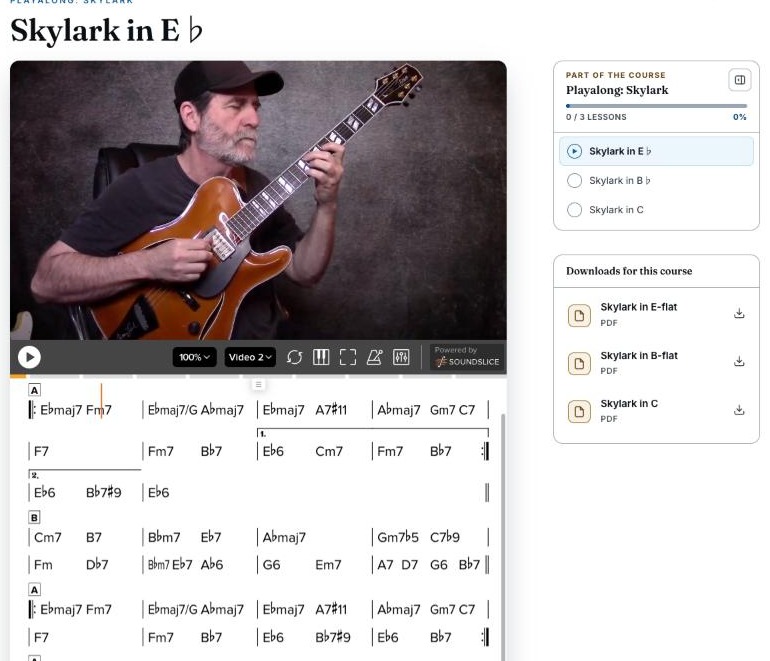
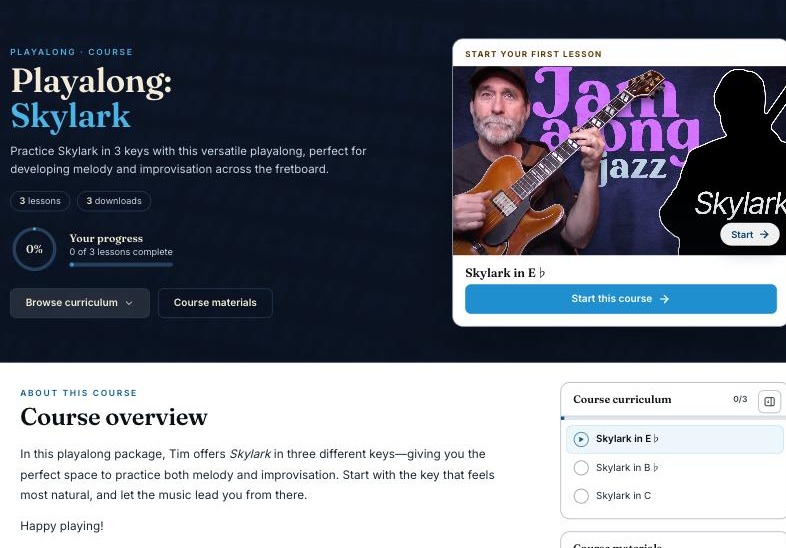
- Skylark in three keys: E♭, B♭ and C
- Easy To Love in C and G, Anthropology at 100 and 160 bpm
- Bye Bye Blues twice: a shooping version and a walking bass version
- 33 PDFs: at least one chart for every tune
- Sheets of Tim's changes for Nature Boy and Tenderly
- A lead sheet with the melody for You Go To My Head
- Videos play on their lesson pages; the PDFs download
A look inside...
The twenty tunes...
1Skylark
Three versions, in E♭, B♭ and C, each with its own chart. Start in the key that feels most natural for the melody, then try the others.
2Anthropology
Two tempos, each with its own chart: 100 bpm for a relaxed, bluesy pace, and 160 bpm for a more traditional bebop tempo.
3Easy To Love
Two versions, in C and in G, with a chart for each, so the same tune sits in two different places on the neck.
4Nature Boy
Tim comps through his own reharmonized arrangement, with inner voice movement, passing chords and tonal shifts to listen for. Comes with a play-along chart and a sheet of Tim's changes.
5Softly, as in a Morning Sunrise
Tim comps with a walking bass line for a solid groove, with chord substitutions in the comping to steer your lines.
6Corcovado
A bossa nova setting for rhythmic phrasing and the tune's subtle harmonic shifts, whether you play single-note lines, comping or chord melody. Two chart PDFs.
7Tenderly
A tender, expressive take on the ballad, made for phrasing, touch and dynamics. Comes with a chart and a sheet of Tim's changes.
8In Walked Bud
Monk's tune with simple comping rhythms over a walking bass line, lively and driving, for bebop phrasing and rhythmic hits.
9Beautiful Love
A minor standard with a relaxed two-feel, walking bass and crisp staccato chords, good ground for arpeggios and melodic minor colors. Two chart PDFs.
10A Nightingale Sang in Berkeley Square
Steady comping in a relaxed two-feel, for chord-tone targeting, motivic ideas and ballad phrasing.
11But Beautiful
A relaxed ballad setting with a steady pulse and plenty of space: just enough rhythm to focus on phrasing and feel.
12Meditation
A warm bossa nova comp with a steady groove, leaving room for the melody, chord melody ideas or your own solo.
13Bye Bye Blackbird
Medium tempo, with a relaxed comp and a steady walking bass underneath. Laid back, with plenty of space for phrasing and time feel.
14Ruby, My Dear
A ballad at a slower tempo, with clear, expressive voicings and a steady pulse that leaves time to think through each phrase. Two chart PDFs.
15On Green Dolphin Street
A relaxed Latin feel at a medium tempo, in a warm groove that leaves the tune room to breathe.
16Bye Bye Blues
Two versions, each with its chart. A slower shooping version (light, bouncy four to the bar, compact voicings, short strokes) and a medium tempo walking bass version closer to the tune's natural feel.
17God Bless the Child
A warm ballad tempo with a gentle bluesy pulse, for the melody and for improvising over bluesy harmony. Two PDFs.
18Black Coffee
A relaxed, ballad-like comp that brings out the tune's smoky blues character, with colorful dominant voicings. Two PDFs.
19You Go To My Head
A relaxed ballad at an easy, unhurried pace. Comes with a chart and a lead sheet, so you can learn the melody first and then improvise over the same changes.
20How Deep Is The Ocean
A gentle two-feel with moments of walking bass, at an easygoing pace for the melody, your phrasing and your own ideas.
Is this for you?
Yes, if…
- You know a few standards and have no one to play them with
- You want to practice melodies and solos against real comping
- You can follow a chord chart through a tune's form
- You want ballads and bossa novas as well as swing
Maybe not, if…
- You want lessons that explain how to play each tune
- You need video files you can download and keep offline
- You are still learning to change chords in time
Practicing with a real accompanist...
Practicing over a backing track is useful up to a point. The track never listens, never leaves space on purpose, and never plays a chord you did not expect. These play-alongs come from Tim’s Tune of the Month series, and every one of them is Tim himself, comping the changes on guitar.
That means real voicings, inner voices that move, passing chords, and a walking bass line when the tune wants one. On Nature Boy he comps through his own reharmonized arrangement. On Bye Bye Blues you get two different rhythm guitar approaches to the same tune.
How to use them
Start with the melody. Many of the tunes are ballads or medium tempos, which leaves room to hear where each melody note sits against the harmony. Then take the same form as a backdrop for improvising, or try chord melody ideas over Tim’s comping. Where a tune comes in more than one key or tempo, start with the one that feels natural and move on from there.
Twenty tunes, a wide spread of feels
Ballads such as Tenderly, But Beautiful and Ruby, My Dear. Bossa novas with Corcovado and Meditation, a relaxed Latin feel on On Green Dolphin Street, a lively, driving In Walked Bud, and the bluesier side of the repertoire in God Bless the Child and Black Coffee. Volume 1 covered ten other standards, and none of them repeat here.
Questions, answered
How is this different from volume 1?
Different tunes and a different delivery. Volume 1 has ten standards, from All The Things You Are to On the Sunny Side of the Street, as a zip of videos with the chord charts on screen. Volume 2 has twenty more tunes, none repeated, and plays on the site, with the charts as separate PDFs.
Can I download the videos?
No. The play-alongs play on their lesson pages in Tim's Guitar Workshop once you log in, so you need an internet connection to use them. The PDF charts download from each page, so you can print them and keep them on the stand.
Are these lessons, or just play-alongs?
Play-alongs. Each video is Tim comping the tune for you to play over, not a lesson about it. Use them to practice the melody, to improvise over the changes, or to try chord melody ideas of your own over Tim's comping.
Do I need to read music?
You need to follow a chord chart. The PDFs give you the changes for every tune, and You Go To My Head also comes with a lead sheet showing the melody. If you learn melodies by ear, the charts are there to keep your place in the form.
Why are some tunes in more than one key or tempo?
So you can choose where to start and then stretch. Skylark comes in E♭, B♭ and C, Easy To Love in C and G, and Anthropology at 100 bpm for a relaxed, bluesy pace and 160 bpm for a more traditional bebop tempo.
Meet your instructor...

Tim Lerch
Tim has played jazz and blues guitar for more than 50 years. He is a member of the Northwest gypsy jazz group Pearl Django, leads the Tim Lerch Trio, plays in a duo with Jamie Findlay, and is an Emmy award-winning composer.
His teaching comes from the players who taught him. Joe Diorio was one of his mentors at GIT, and he learned his approach to chord voicings directly from Ted Greene. Those ideas run through every lesson in the Workshop.
His books include Melodic Jazz Guitar Chord Dictionary, Melodic Jazz Guitar Chord Phrases and Melodic Blues Guitar Soloing. He has recorded ten master class courses for TrueFire and taught at jazz guitar camps in the US and UK.
- Emmy-winning composer
- Member of Pearl Django
- 50 years performing
Buy it on its own, or get everything
- Yours to keep, on your My Courses page
- Video lessons with the notation, on any device
- No subscription
- This and every other course and lesson
- Livestreams and the member community
- New releases every week