
Line Cliches
Hold the chord, move one voice, and a static bar starts to go somewhere
$19.99
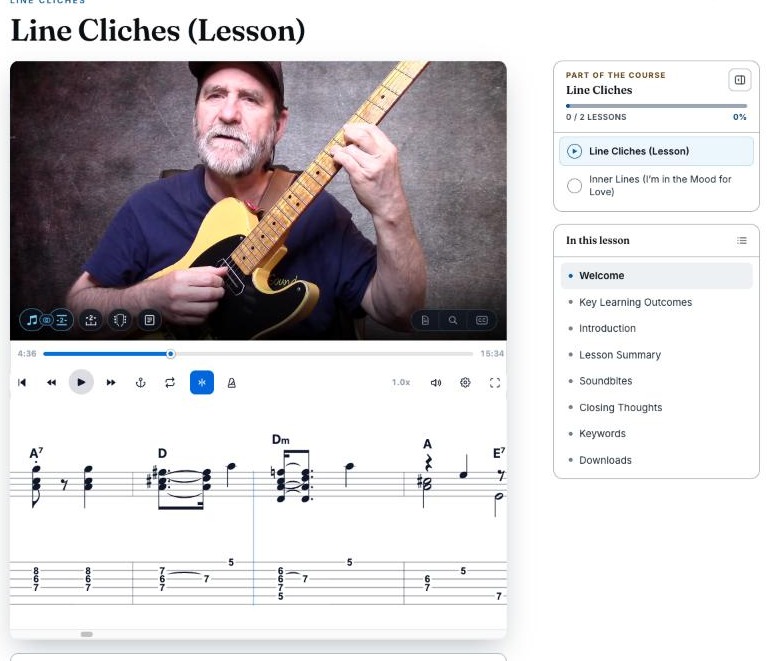
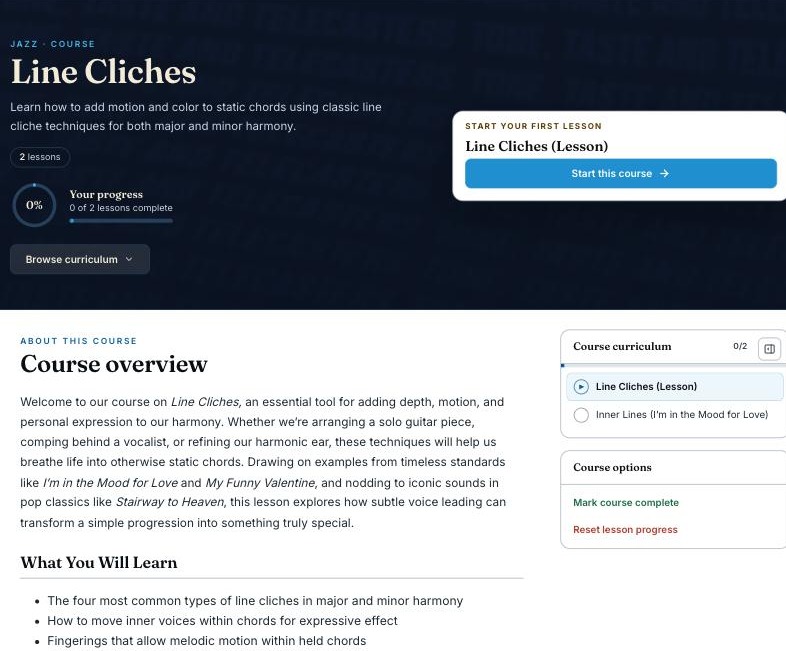
Two bars of A minor can just sit there, or they can move. Tim shows the four common line cliches, the chromatic lines that run inside a held chord, then takes the idea into I’m in the Mood for Love, adding inner voices between melody and bass that can change every time you play.
Every course and lesson on the site, this one included. Free for 7 days, then $24.99 a month.
Start your free trialWhy you'll love it...
Sounds you already know
Tim traces line cliches from Blue Skies and My Funny Valentine to Cry Me a River, Stairway to Heaven and I Just Called to Say I Love You. Once you can play them, you hear them everywhere.
Four patterns cover most of it
Descending root and rising fifth, on minor and on major chords. Learn those four and you have the common cases, with the moving line placed in the bass, the middle or on top.
Add them where none are written
A static bar of A minor is an invitation. You can put your own line cliche into a tune when the composer did not, quickly over a short chord or stretched out over a slow one.
Read any lead sheet's version
The same line might be written Am, Am(maj7), Am7, Am6, or as Eaug over A and Dm9 over A. Tim shows the different spellings so a chart stops hiding the cliche from you.
Grips that leave a finger free
Fingering matters here. Tim chooses chord shapes that hold the harmony while leaving fingers available to move a line underneath or between the other voices.
Arrangements that never repeat
Inner lines can move slowly, quickly or not at all. Tim treats them as the improvised part of an arrangement, so a tune you know can sound a little different each time.
What's inside
- 2 video lessons, 22 minutes in total
- Line Cliches lesson PDF
- Inner Lines (I'm in the Mood for Love) PDF
- The four common line cliches, on minor and major chords
- Moving lines in the bass, in the middle voice and on top
- Rising fifth and falling root combined, meeting at the sixth
- Alternate chord names for the same cliche on a lead sheet
- Inner voice counter-lines over the opening of I'm in the Mood for Love
A look inside...
What you'll learn...
1Line Cliches
A line cliche is movement inside a static chord. Tim covers the four common types: minor with the root descending (A, G♯, G, F♯), minor with the fifth rising (E, F, F♯, G), and major with the root descending or the fifth rising, both heading toward F minor in C. Then the line moves to the bass, middle and top, and the alternate chord names are decoded.
2Inner Lines (I'm in the Mood for Love)
A short lesson on the middle of the chord. Over the opening phrase Tim adds a chromatic line descending from B, rests over E minor, plays a line from the ninth of D minor to the flat seven of A7, then a Stairway-style move over D minor to G7 with F in the bass. Your job: invent counter-lines over the I-vi-ii opening.
Is this for you?
Yes, if…
- You play chord melody or comp and your held chords sound static
- You arrange standards for solo guitar and want more inside them
- You accompany a singer and want movement that stays out of the way
- You can hold a chord shape while one finger moves on its own
Maybe not, if…
- You are still working on open chords and your first barre shapes
- You are looking for single-note soloing material
- You want a fixed arrangement to learn exactly as written
Movement inside a still chord...
Some of the most familiar sounds in popular music come from one voice moving while everything else stays put. The bass holds A, the chord stays minor, and a single note slides down a half step at a time. The harmony barely changes, yet the bar suddenly has somewhere to go.
It is an old sound. Tim traces it from Irving Berlin’s Blue Skies, and Thelonious Monk’s In Walked Bud built on the same changes, through Cry Me a River and My Funny Valentine to Stairway to Heaven and I Just Called to Say I Love You.
Written in, or added by you
Sometimes the composer writes the line. Just as often, wherever a chord sits for a bar or two, you can supply one yourself, quickly over a short duration or stretched across a slower one. That is where the lesson stops being theory and becomes an arranging tool.
You can often add your own line cliche to create a little movement inside an otherwise static situation.
From pattern to arrangement
The second lesson takes the idea into a real tune. Tim designed his I’m in the Mood for Love material as a template for expansion rather than a finished piece, and here he shows what expansion means: inner lines that lead down into the bass or up into the melody, chosen fresh each time you play. His suggestion for practice is to take one phrase and find as many counter-melodies for it as you can.
Two lessons, twenty-two minutes, and a held chord never sounds quite so still again.
Questions, answered
Do I need to read music?
No. Every example is played and explained on the guitar. The two PDFs give you the written examples to work from, and Tim suggests treating the video, the tab or the lead sheet as a jumping-off point for your own variations.
Is this only useful for jazz?
No. Tim's examples run from Irving Berlin and Monk to Stairway to Heaven and I Just Called to Say I Love You. Line cliches work wherever a chord sits still: in solo guitar, behind a singer, or in songs you write yourself.
Do I need to know I'm in the Mood for Love?
It helps to know how the tune goes. The second lesson works over a simple arrangement of its opening phrases and I-vi-ii changes, adding moving inner lines rather than teaching the melody from scratch.
How hard is this to play?
Intermediate. The chord shapes are familiar, but holding a chord while one finger moves a line takes control, and Tim includes some challenging contrapuntal ideas, such as a rising fifth and a falling root moving at the same time.
How do I get the lessons?
Both lessons play on their own lesson pages at Tim's Guitar Workshop once you log in. The videos stream there rather than download, and each lesson's PDF downloads from the page it belongs to.
Meet your instructor...

Tim Lerch
Tim has played jazz and blues guitar for more than 50 years. He is a member of the Northwest gypsy jazz group Pearl Django, leads the Tim Lerch Trio, plays in a duo with Jamie Findlay, and is an Emmy award-winning composer.
His teaching comes from the players who taught him. Joe Diorio was one of his mentors at GIT, and he learned his approach to chord voicings directly from Ted Greene. Those ideas run through every lesson in the Workshop.
His books include Melodic Jazz Guitar Chord Dictionary, Melodic Jazz Guitar Chord Phrases and Melodic Blues Guitar Soloing. He has recorded ten master class courses for TrueFire and taught at jazz guitar camps in the US and UK.
- Emmy-winning composer
- Member of Pearl Django
- 50 years performing
Buy it on its own, or get everything
- Yours to keep, on your My Courses page
- Video lessons with the notation, on any device
- No subscription
- This and every other course and lesson
- Livestreams and the member community
- New releases every week