Triads: The Complete Guide
Find any triad on the neck, then turn it into altered, Lydian and bluesy sounds
$34.99
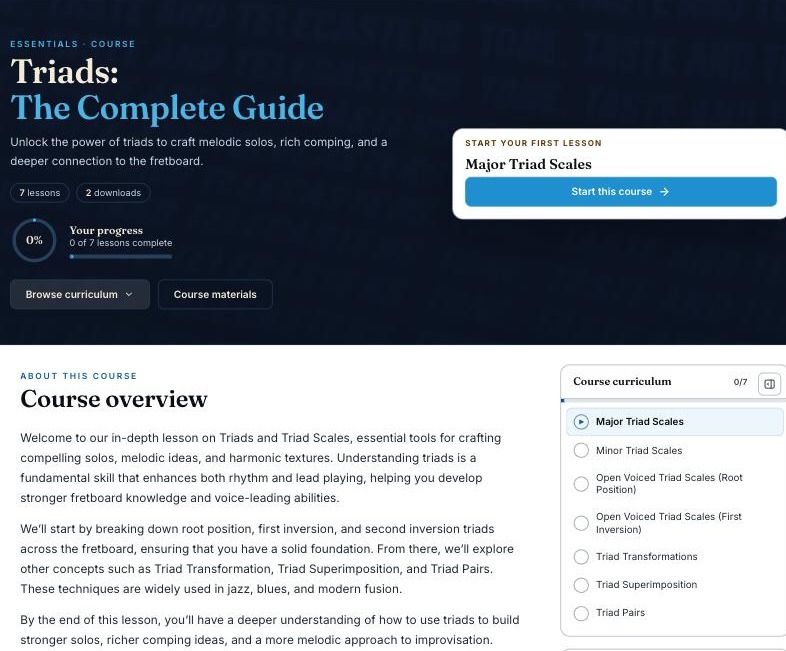
Tim admits triad scales sound like a child’s piano exercise at first. He works them through all twelve major keys, three inversions and four string sets, then natural, harmonic and melodic minor. Then they turn musical: suspensions and line clichés, triads over a held bass note, and triad pairs over an altered dominant.
Every course and lesson on the site, this one included. Free for 7 days, then $24.99 a month.
Start your free trialWhy you'll love it...
The drill, then the payoff
Tim is honest that triad scales sound like piano practice at first. The later videos show why they are worth it: the same shapes become blues phrases, ballad fills and altered dominant lines.
The neck, one key at a time
Each key is played as its seven triads on one string set, moving up in fourths, so you learn where the harmony of a key lives rather than a pile of separate grips.
Minor keys you can hear
Harmonic minor's augmented triad and its two major triads a half step apart, melodic minor's pairs a whole step apart. Tim has you repeat them until the sound is in your ear.
More sounds from fewer shapes
A Cmaj7 already holds an E minor triad. Once you see overlaps like that, shapes you know cover chords you thought needed new voicings.
Color without a fourth voice
Suspensions, three-note dominant and minor sevenths, rising and falling line clichés. Each changes a single note, so the voice leading stays clean and the texture stays light.
A simple way into altered sounds
Over a G7 altered, Tim takes two triads from A♭ melodic minor, D♭ and E♭, and phrases with them. Outside sounds without running a scale up and down.
What's inside
- 7 videos, 1 hr 45 min in total
- Major triad scales in root position, first and second inversion
- Natural, harmonic and melodic minor triad scales
- Open-voiced triad scales in F, B♭ and E♭, two inversions
- Triad transformations: suspensions, three-note sevenths, line clichés
- Triad superimposition: major triads climbing over a held G bass
- Triad pairs, in C major and over a G7 altered
- A PDF for each of the seven lessons
- Two more PDFs: harmonic and melodic minor open-voiced triad scales
A look inside...
What You'll Learn
1Major Triad Scales
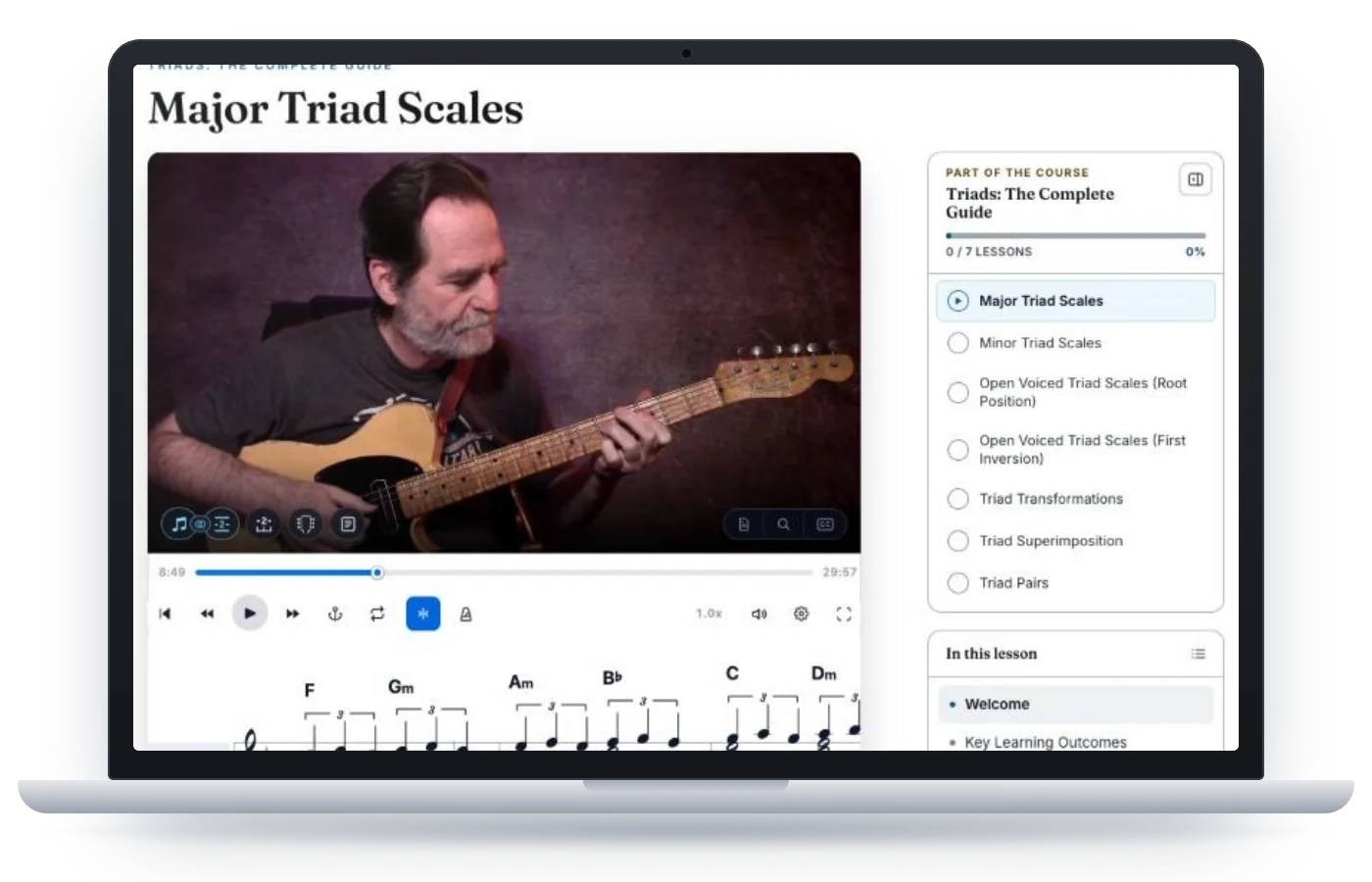
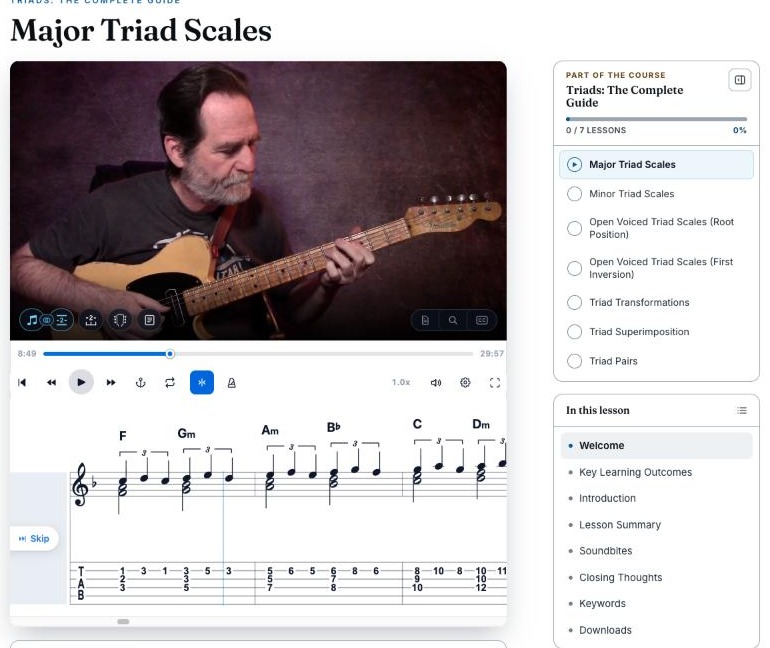
Every note of the major scale harmonized as a triad, in root position, first and second inversion, on four string sets. Keys move up in fourths from G until all twelve are covered. Tim adds melody on top, such as the fifth rising to the sixth, shows the E minor triad inside Cmaj7, and plays a short blues passage built almost entirely from these shapes.
2Minor Triad Scales
Natural minor first, which is the major scale from its sixth degree, so the shapes are already familiar. Then harmonic minor, with its augmented triad on the flat third and two major triads a half step apart, and melodic minor, with major and diminished pairs a whole step apart. All three inversions, twelve keys, and why B♯ and F♭ get those names.
3Open-Voiced Triads in Root Position
Octave-displaced triads: three notes spread over four strings, so the outside interval is wider than an octave. Worked in F, B♭ and E♭ with a thumb, first and third finger right hand. Tim decorates each chord with a 3-4-5 melody that follows the key, keeps the chord sustained underneath, and uses a slant finger on the top set.
4Open-Voiced Triads in First Inversion
The 3-1-5 shapes, again in F, B♭ and E♭, keeping the same fingers and letting the shapes shrink where needed. Tim kept only the voicings that finger well and suit arrangements. Decorations include the outside notes followed by the root in the middle, and an inner voice that trades the root with the seventh.
5Triad Transformations
One D major triad, changed a note at a time. Sus4 and sus2, two ways to turn a major triad into a three-note dominant seventh, and the same moves for minor sevenths, including the F triad that works as a rootless Dm7. Then a rising fifth line cliché in major and a falling root line cliché in minor.
6Triad Superimposition
A low G held while a major triad climbs above it in half steps. A♭ gives an altered G7, A a Lydian sound, D♭ a strongly altered dominant that Tim drops into a ii-V-I in C, and E the 13♭9 from the diminished world. He then sorts the results into major, minor and dominant families.
7Triad Pairs
Two neighboring triads that cover six of the seven notes in a key. F and G in C major first, played with a doubled root for an even eight-note pattern. Then a G7 altered heard as A♭ melodic minor, with the D♭ and E♭ triads leading into C, and C and D triads for a C7♯11 sound.
Is this for you?
Yes, if…
- You know some triad shapes but not where they sit in each key
- You want harmonic and melodic minor under your fingers as chords
- You want altered and Lydian colors without new four-note voicings
- You are happy to drill shapes before they start sounding like music
Maybe not, if…
- You are still learning open chords and your first barre shapes
- You want to know where triads come from first: Harmony 101 starts there
- You want finished licks or tunes rather than a system to practice
Why three notes go so far...
Tim does not pretend triad scales are thrilling. Played up and down a key, he says, they sound a bit like a child practicing the piano. His point is that this is the work that has to come first, because once the shapes are under your fingers almost everything else in the course is built from them.
Organized by key, not by shape
Rather than learning a G major triad in twelve places, you learn the seven triads of a key on one string set, then move up a fourth to the next key. Root position, first inversion and second inversion each take four keys, which covers all twelve. Tim warns that you will hate him for the flat keys and appreciate them later. The B string, which shifts every shape that crosses it, is dealt with as it comes up.
Then the shapes start to sing
The later videos are where the drilling pays off. Change one note and a major triad becomes a sus chord, a dominant seventh or the start of a line cliché. Hold a G in the bass and slide a triad above it, and you get Lydian, altered and diminished colors from a shape you already know. Take two neighboring triads from a scale and you have a way through an altered dominant that sounds like melody rather than a scale exercise.
Leave that to the scholars. We’re players. We want to be able to play this stuff.
That is Tim on the habit of naming every new six-note collection as a scale of its own. It is a fair summary of the whole course: a small number of shapes, learned properly, and then used.
Questions, answered
How is this different from Harmony 101?
Harmony 101 is the primer: where triads come from and how they grow into four-note chords. This course assumes you have that idea and goes much further with triads alone, through every major key, three minor scales and open voicings, then transformations, superimposition and triad pairs.
Does this overlap with Arpeggios: The Complete Guide?
Only at the edges. The arpeggios course is about four-note seventh chord fingerings, played as lines. This one stays with three-note triads, played as chords as well as lines, and then uses them for color. The two work well side by side.
Do I need to read music?
No. Tim names every chord as he plays it, and the shapes are shown on the fretboard throughout, so the video alone is enough to follow along. Each lesson also has a PDF to work from when you practice away from the screen.
What level do I need to be?
Comfortable with barre chords and the major scale. Tim points out where these triads sit inside barre chord shapes you already know. The early videos are drills, so patience matters more than speed, and the superimposition and triad pair videos lean on some jazz harmony.
How do I get the videos and PDFs?
The seven videos play on their lesson pages in Tim's Guitar Workshop once you log in. They stream there rather than download. Each lesson's PDF downloads from its page, and the two open-voiced minor triad scale PDFs download from the course page.
Meet your instructor...

Tim Lerch
Tim has played jazz and blues guitar for more than 50 years. He is a member of the Northwest gypsy jazz group Pearl Django, leads the Tim Lerch Trio, plays in a duo with Jamie Findlay, and is an Emmy award-winning composer.
His teaching comes from the players who taught him. Joe Diorio was one of his mentors at GIT, and he learned his approach to chord voicings directly from Ted Greene. Those ideas run through every lesson in the Workshop.
His books include Melodic Jazz Guitar Chord Dictionary, Melodic Jazz Guitar Chord Phrases and Melodic Blues Guitar Soloing. He has recorded ten master class courses for TrueFire and taught at jazz guitar camps in the US and UK.
- Emmy-winning composer
- Member of Pearl Django
- 50 years performing
Buy it on its own, or get everything
- Yours to keep, on your My Courses page
- Video lessons with the notation, on any device
- No subscription
- This and every other course and lesson
- Livestreams and the member community
- New releases every week