I-VI-ii-V Licks
Bluesy swing lines through the I-VI-ii-V that still know where the chords are
$14.99
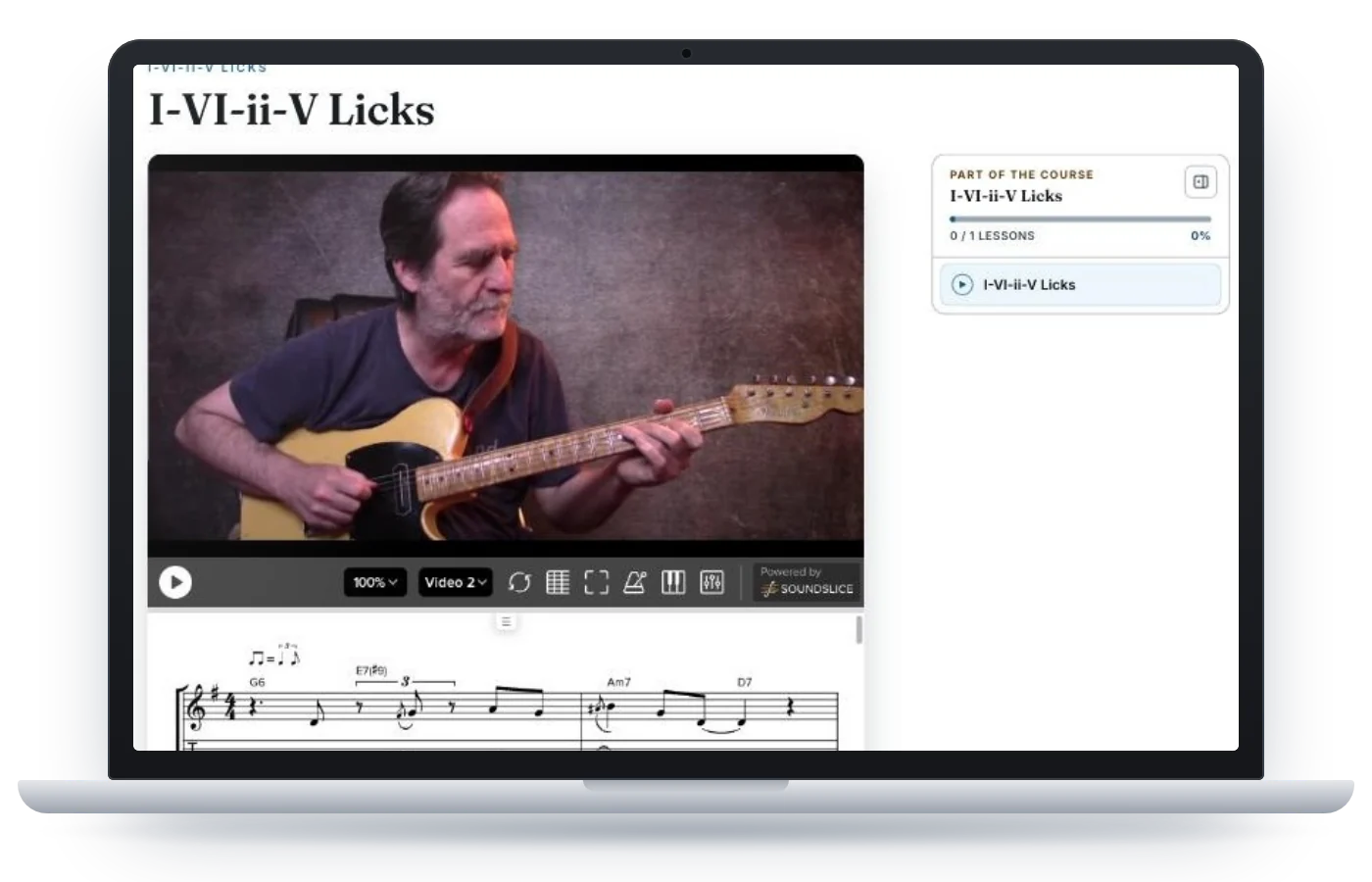
The I-VI-ii-V is where a swing blues turns around, and it is easy to ignore the chords or to sound academic. Tim loops the changes in G, starts from blues vocabulary, then leans further into the chord tones, like the G♯ that marks the E7.
Every course and lesson on the site, this one included. Free for 7 days, then $24.99 a month.
Start your free trialWhy you'll love it...
Your ear leads, theory follows
Tim starts with familiar blues phrasing over the changes, then adds chord-specific targeting. The aim is a balance: letting your ear lead while still knowing what each note is doing.
Small shifts, real color
Moving from G to G♯ as the E7 arrives is one example of how a single note adds tension and color. You learn where those moments sit, without the lines turning academic.
Pick one and make it yours
Tim's suggestion is to choose the idea that speaks to you, learn it deeply, move it around the neck and stretch it into something personal. There is no rush to learn it all.
What's inside
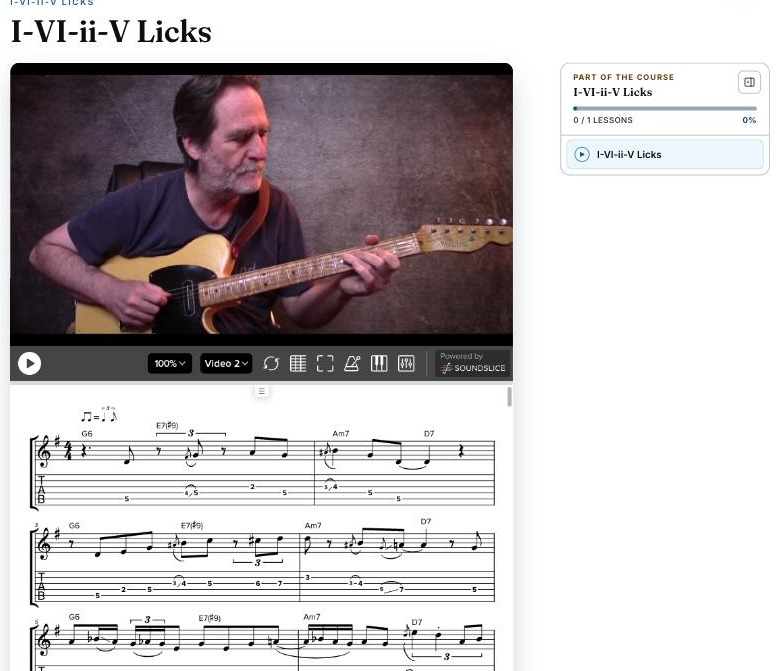
- One video lesson that plays in a notation player on the lesson page
- PDF: I VI ii V Swing Blues Turn Arounds, 20 pages of notation and tab
- 24 eight-bar lines over G6, E7♯9, Am7 and D7, 192 bars in all
- Swing eighths, with colors such as E7alt, D13 and D7♭9 along the way
- Lines that move from blues phrasing toward chord-tone targeting
A look inside...
Is this for you?
Yes, if…
- You play swing blues and the turnaround chords slip past you
- You want jazzier lines that keep their blues feel
- You can learn a line from tab or notation
- You like to choose one idea and work it over properly
Maybe not, if…
- You want each phrase numbered and explained one by one
- You need a backing track download to practice with
- You are still getting comfortable with a basic 12-bar blues
Between the blues and the changes...
The I-VI-ii-V is the engine of a swing blues turnaround, and it catches players in one of two ways. Either they play straight blues through it and the chords go unacknowledged, or they switch to careful chord-tone lines and the blues drains out.
Tim works in the space between. Over a looping backing track in G, he starts with blues vocabulary to get through the changes, then gradually brings in more chord-specific targeting. Small shifts carry a lot of weight: moving from G to G♯ as the E7 arrives is enough to add tension and color without sounding academic.
Melodies that orbit the chord shapes
Many of the lines sit around familiar chord shapes rather than running scales, which is why they sound like melodies. The changes are G6 and E7♯9 in one bar, Am7 and D7 in the next, and along the way richer colors turn up, such as E7alt, D13 and D7♭9, all written out across the 24 eight-bar lines in the PDF.
Tim’s suggestion is not to learn it all. Pick the one idea that speaks to you, learn it deeply, move it around the neck and stretch it into something personal. Loop the changes and take your time.
It pairs naturally with Melodic Jazz Guitar ii-V-I Licks, which works on the cadence by itself in C, and with the jazz blues turnarounds in Blues Licks and Turnarounds, which treat the same progression in chords.
Questions, answered
How does this relate to Melodic Jazz Guitar ii-V-I Licks?
It takes the cadence somewhere new. Melodic Jazz Guitar ii-V-I Licks works on it by itself, in C major and C minor. Here the ii-V is the second half of a two-bar I-VI-ii-V in G with a swing blues feel. For the same progression played in chords, see the jazz blues turnarounds in Blues Licks and Turnarounds.
Is a backing track included?
No, there is no backing track download. Tim plays over a looping track in the video, and the changes are easy to loop yourself: G6 to E7♯9 in one bar, Am7 to D7 in the next.
Do I need to read music?
No, tab is enough. The PDF gives all 192 bars in standard notation and tab, and the video plays with the notation on screen. The 24 lines run on from one to the next, each closed by a double barline, so pick one you like and loop it.
How do I get the lesson?
At checkout you create a login for Tim's Guitar Workshop, and the lesson appears on your My Courses page. The video plays on the lesson page with the notation alongside it (it is not a video download), and the PDF downloads from the same page.
Meet your instructor...

Tim Lerch
Tim has played jazz and blues guitar for more than 50 years. He is a member of the Northwest gypsy jazz group Pearl Django, leads the Tim Lerch Trio, plays in a duo with Jamie Findlay, and is an Emmy award-winning composer.
His teaching comes from the players who taught him. Joe Diorio was one of his mentors at GIT, and he learned his approach to chord voicings directly from Ted Greene. Those ideas run through every lesson in the Workshop.
His books include Melodic Jazz Guitar Chord Dictionary, Melodic Jazz Guitar Chord Phrases and Melodic Blues Guitar Soloing. He has recorded ten master class courses for TrueFire and taught at jazz guitar camps in the US and UK.
- Emmy-winning composer
- Member of Pearl Django
- 50 years performing
Buy it on its own, or get everything
- Yours to keep, on your My Courses page
- Video lessons with the notation, on any device
- No subscription
- This and every other course and lesson
- Livestreams and the member community
- New releases every week