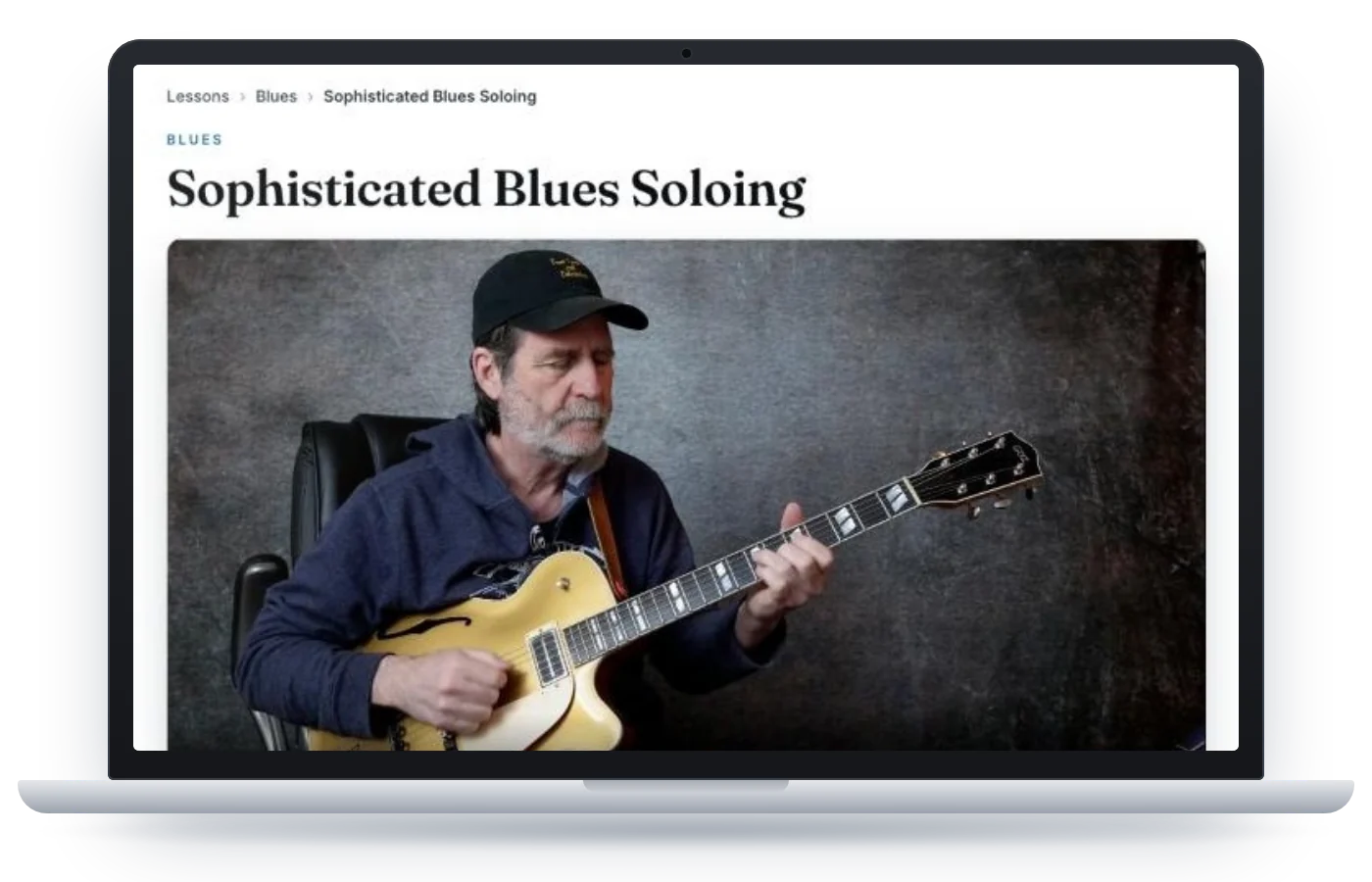
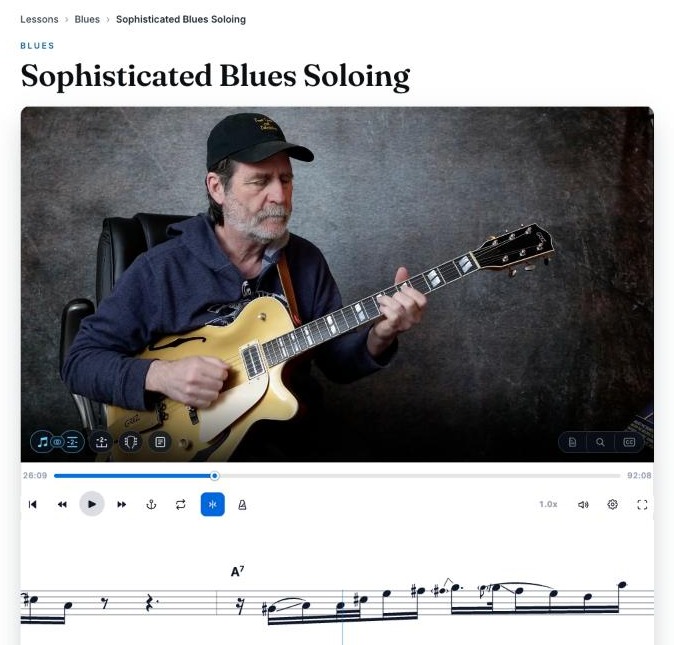
Sophisticated Blues Soloing
Bring jazz color into your blues lines without losing the blues feeling
$29.99
Most blues players know the minor pentatonic and stop there. Over a slow 12-bar blues in A, Tim adds one device at a time, from the sixth and ninth to arpeggios, approach from above, diminished and altered sounds, and plays a chorus or two of each so you hear exactly what it does.
Every course and lesson on the site, this one included. Free for 7 days, then $24.99 a month.
Start your free trialWhy you'll love it...
It still sounds like the blues
Tim keeps the earthy feel throughout. The minor pentatonic stays as the scaffolding and every jazz color is added to it, so your playing gets richer without turning into bebop.
One device at a time
Each idea is explained, then heard over a chorus or two of the same slow blues in A. With the band unchanged, you hear exactly what the new note or shape does to the line.
Sounds, not scale names
Tim skips the habit of naming every variation. Know where the sixth, the ninth and the natural third live and what they sound like, and the theory stays out of your way.
Hipper than the band
Approach from above, diminished and altered sounds work even when the rhythm section plays plain changes. Tim shows where in the bar to put them so the tension resolves.
Touch and timing as tools
Dynamics get real time: volume from how firmly you grip the pick, high against low, and what Tim calls sooner or later, laying back or pushing the beat to move the listener.
Toward the modern blues sound
The lesson ends on a modal vamp in G, mixing Dorian and Mixolydian with blues vocabulary, the territory Tim connects with Robben Ford, Larry Carlton and Steely Dan.
What's inside
- One video lesson, 1 hr 32 min
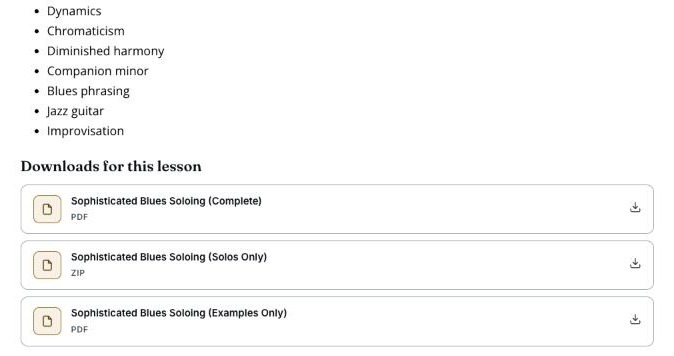
- Complete lesson PDF
- Solos-only download (ZIP)
- Examples-only PDF
- Demonstration choruses for every device, over a slow blues in A
- Companion minor and diatonic substitutions over dominant chords
- A modal blues vamp in G, played Dorian and Mixolydian
A look inside...
How the lesson unfolds...
1The pentatonic foundation
The track is a slow 12-bar blues in A, with each chord approached from a half step above. Tim starts with plain A minor pentatonic and the occasional flat fifth, and listens for the basics first: laying back on the beat, a round singing tone, and repetition the listener can follow.
2The sixth, the natural third and the ninth
Three colors added one at a time. The sixth (F♯ over A7, which is also the third of D7), the natural third alongside the flat third, then the ninth that bends toward the blue third. Tim points out the habits: flat three before natural three, and the sixth bent up to the flat seven.
3Arpeggios of the chord of the moment
Dominant seventh arpeggios for A7, D7 and E7, dressed up with the sixth and ninth. Tim takes one small idea and moves it to the 10th and 12th frets for the D and the E. Stiff at first, it becomes lines that address the changes, closer to a sax or piano player's blues.
4Approach from above
Superimposing the chord a half step above the target, such as E♭9 on the way to D9, even when the band is not playing it. Tim puts the tension near the end of the bar, fits a few quick notes in, and resolves by half step so the funny notes land.
5Diminished devices
Leading tone diminished (A7♭9, or B♭ diminished, on the way to D, and F diminished back to A) and common tone diminished (A diminished over A7 and over D7). Tim prefers the arpeggio to the scale and shows how each shape repeats every three frets. Then a chorus mixing both with approach from above.
6The altered sound
Two funny fives and two funny nines. The altered scale comes from melodic minor a half step up: B♭ melodic minor over A7, F melodic minor over E7, used in the last beats of bar four and on the V. Plus the Lydian dominant sound on the IV, from A melodic minor.
7Chromaticism and ornaments
Filling the gaps between notes you already know with chromatic steps, and sticking the landing on a chord tone. Then the ornaments that make a line dance: hammer-on and pull-off figures, slides, bends and vibrato, worked through over a couple of choruses so you hear the variations.
8Dynamics: loud and soft, sooner or later
Volume from grip pressure on an extra heavy pick rather than a harder arm, with an experiment you can try on a single note. Then phrasing that announces a line and grows again at the end, register as a dynamic, and timing that lays back or pushes the beat.
9Companion minor and a modal vamp in G
The companion minor Tim learned from Ted Greene (E minor 7 over A7), then the family of arpeggios built on the root, third, fifth and seventh, including Wes Montgomery's major seventh down a whole step. The lesson closes over F/G, mixing Dorian, Mixolydian and blues vocabulary.
Is this for you?
Yes, if…
- You solo from the minor pentatonic and want more harmony in your lines
- You like the Robben Ford and Larry Carlton sound and want its sources
- You know some dominant seventh arpeggio shapes, or are ready to
- You want touch, timing and dynamics treated as seriously as notes
Maybe not, if…
- You are still learning your first blues scale
- You only want the Stevie Ray Vaughan or Muddy Waters sound
- You want a short lick lesson rather than an hour and a half of study
What makes blues sophisticated...
Tim opens with a caveat about the word. John Lee Hooker can sound primitive and still be deeply sophisticated, because he knows exactly what he is doing and does it every time. So this lesson is not about fancier being better. It is about the devices that lean the blues toward jazz, creating tension and release inside a 12-bar form, while the feeling stays earthy.
One track, many ways through it
The whole lesson sits on one slow blues in A. Tim explains a device, then plays a chorus or two of it over the same track, roughly a minute at a time. Because the band never changes, every new color is easy to hear: the sixth and ninth, the arpeggios of the chord of the moment, the half step approach, the diminished and altered sounds. Most of the time, he points out, the band is not playing the substitution at all. You are.
Know where it lives and what it sounds like. Don’t worry about scales.
Numbers, not names
Tim is wary of giving every scale variation its own name, which he says leaves you with scrambled eggs in your head. Instead he describes each note by its relationship to the chord of the moment, so the same F♯ is the sixth of A7, the third of D7 and the ninth of E7 in turn.
Where it comes from
The companion minor idea came from Ted Greene. The major seventh down a whole step is a device Tim credits to Wes Montgomery. The modal vamp at the end points toward Robben Ford, Larry Carlton and Steely Dan. Tim is honest that you probably won’t get away with any of this in a Stevie Ray Vaughan tribute band. It belongs in your playing when you want the blues to say a little more.
Questions, answered
Do I need to read music?
No. Every device is explained and played on the guitar, and Tim talks through where each note sits against the chord. The complete PDF and the examples PDF write out what he plays, so reading helps when you want to learn a chorus note for note.
How is this different from Blues by the Numbers?
Blues by the Numbers stays with the blues pool: the two thirds, the sixth, the ninth and the blue third. This lesson covers those colors early, then moves on to arpeggios, approach from above, diminished and altered sounds, chord substitutions and a modal vamp.
How much theory do I need first?
Comfort with A minor pentatonic and a few dominant seventh arpeggio shapes. Tim explains each device as he goes, and for deeper background he points to the arpeggio and diminished deep dives elsewhere on Tim's Guitar Workshop.
Will these sounds work on a traditional blues gig?
Used sparingly, yes. Tim's advice is to put the altered sounds in the last two beats of a bar rather than make the whole bar about them. He is also candid that a Stevie Ray Vaughan tribute band is probably not the place for them.
How do I get the lesson?
The video plays on its lesson page at Tim's Guitar Workshop once you log in. It is not a video download. The complete PDF, the examples-only PDF and the solos-only ZIP all download from that same page.
Meet your instructor...

Tim Lerch
Tim has played jazz and blues guitar for more than 50 years. He is a member of the Northwest gypsy jazz group Pearl Django, leads the Tim Lerch Trio, plays in a duo with Jamie Findlay, and is an Emmy award-winning composer.
His teaching comes from the players who taught him. Joe Diorio was one of his mentors at GIT, and he learned his approach to chord voicings directly from Ted Greene. Those ideas run through every lesson in the Workshop.
His books include Melodic Jazz Guitar Chord Dictionary, Melodic Jazz Guitar Chord Phrases and Melodic Blues Guitar Soloing. He has recorded ten master class courses for TrueFire and taught at jazz guitar camps in the US and UK.
- Emmy-winning composer
- Member of Pearl Django
- 50 years performing
Buy it on its own, or get everything
- Yours to keep, on your My Courses page
- Video lessons with the notation, on any device
- No subscription
- This and every other course and lesson
- Livestreams and the member community
- New releases every week